Window and Door Weather Stripping for Energy Efficiency and Noise Reduction
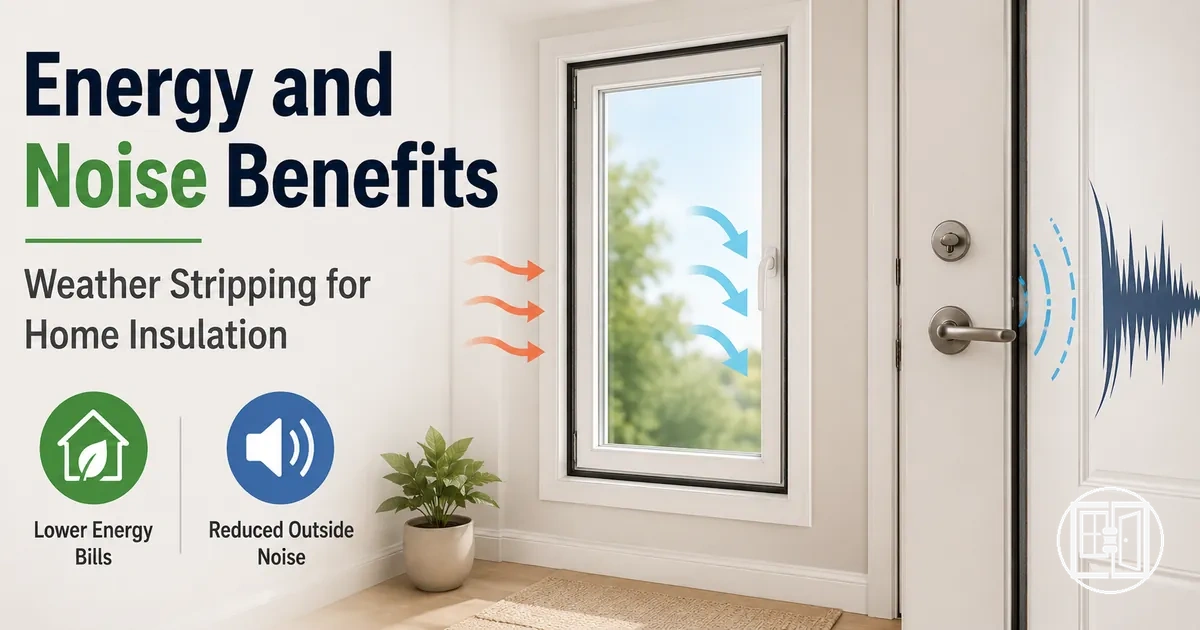
Window and door weather stripping is an air-sealing measure that helps reduce air leakage around door gaps, window gaps, and frame edges. It can improve energy efficiency and support noise reduction when consistent seal contact limits the movement of air and airborne sound through those openings.
Door gaps and window gaps can allow unwanted airflow between indoor and outdoor spaces. This air leakage can contribute to heat loss, increase heating and cooling demand, and create paths for airborne sound to enter the home. Weather stripping helps reduce these effects by improving seal contact where the moving part of the door or window meets the frame.
Benefits are often more noticeable when gaps are visible, seal contact has deteriorated, or drafts are already present. The outcome depends on home conditions, the size and location of the gaps, the condition of the frame, and how effectively the weather seal closes the opening. If little air leakage exists, the overall change may be limited.
Weather stripping can improve air sealing, energy efficiency, and gap-related noise reduction, but it is not a complete insulation system or a full soundproofing solution. Air sealing addresses leakage around openings, whereas broader insulation, glazing, HVAC performance, ventilation, and acoustic upgrades influence other sources of heat transfer and sound transmission.
The following sections explain how weather stripping changes the seal around doors and windows by improving contact along the opening and reducing leakage paths.
How Weather Stripping Changes the Door and Window Seal
Weather stripping is a fitted seal that reduces uncontrolled air movement around operable doors and operable windows. It creates seal contact between the moving panel and surrounding frames so perimeter gaps close more effectively when the opening is shut.
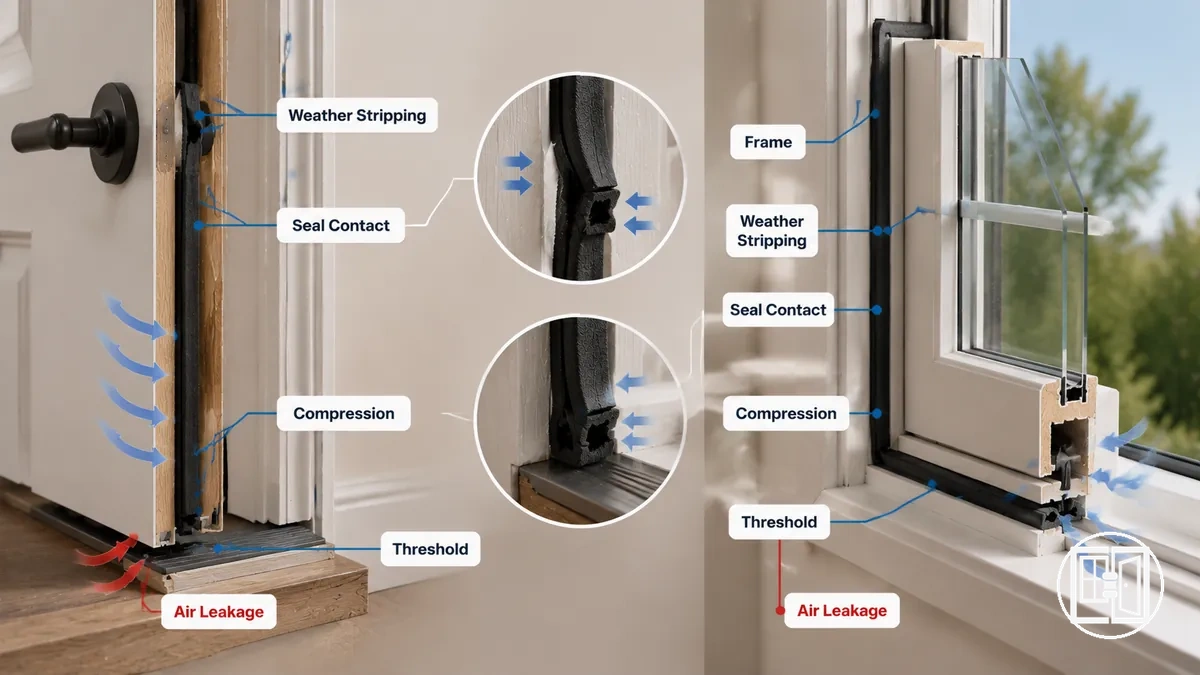
When the door or window closes, the weather stripping compresses against frames, sashes, thresholds, or stops to maintain consistent seal contact. This compression can reduce air movement, drafts, and air leakage that pass through small perimeter gaps. It may also limit gap-based sound paths where airborne sound enters around the edges rather than through the wall, door assembly, or window assembly.
For an overview sealing basics, weather stripping should be understood as sealing a gap rather than insulating an entire wall, window assembly, or door assembly. Gap sealing helps control perimeter leakage, while insulation addresses different aspects of thermal and acoustic performance across the full assembly.
Energy Efficiency Benefits From Reduced Air Leakage
Reduced air leakage can support energy efficiency by limiting unwanted heat exchange through door and window gaps. The benefit depends on gap location, leakage severity, seal quality, and HVAC use, so the effect varies from one building to another.
When air leakage occurs around doors and windows, conditioned air can escape while outdoor air enters the building. This unwanted heat exchange can make indoor temperature stability more difficult to maintain and may increase heating demand or cooling demand. By improving leakage reduction around gaps, weather stripping can help the HVAC system maintain indoor conditions with less unnecessary air movement, although the overall benefit depends on seal quality and the extent of the leakage.
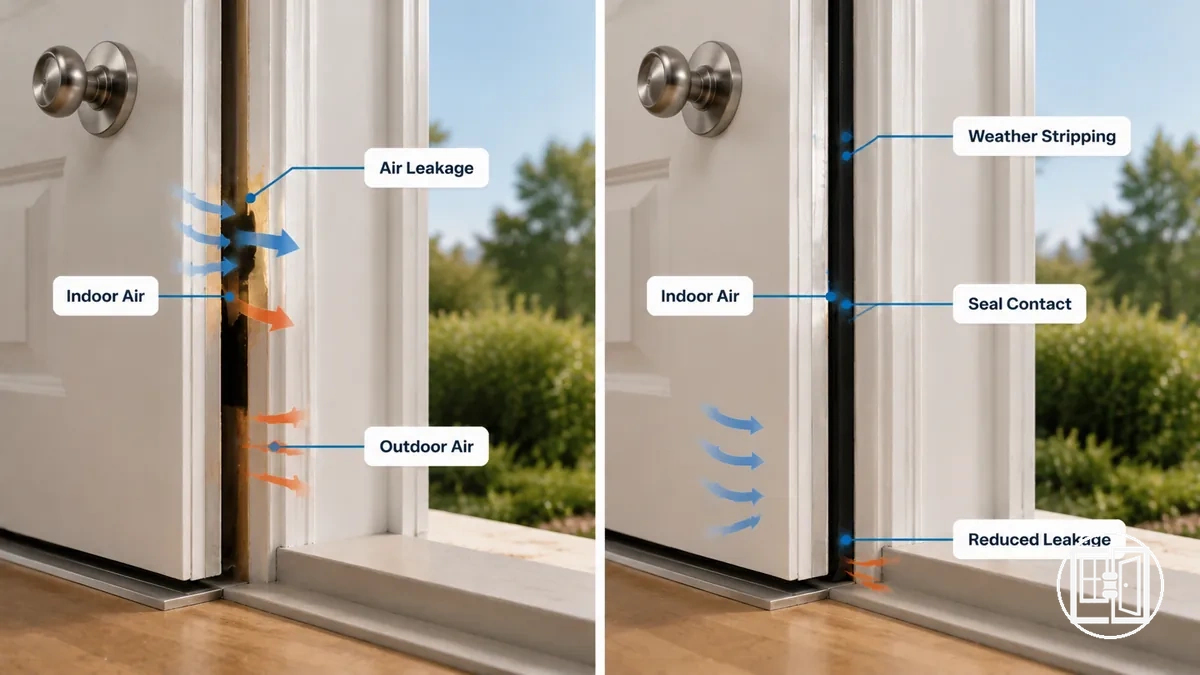
The energy efficiency effect is influenced by multiple conditions rather than by weather stripping alone. The table below summarizes the main factors that affect how reduced air leakage may influence energy use.
| Factor | What changes | Why it matters |
|---|---|---|
| Gap location | Location of air leakage around doors or windows | Different gaps can contribute differently to unwanted heat exchange. |
| Leakage severity | Amount of uncontrolled air movement | Greater leakage often provides more opportunity for improvement when sealed. |
| Seal quality | Consistency of seal contact | Better seal contact can improve leakage reduction and indoor temperature stability. |
| Climate load | Heating or cooling demand | Larger indoor-to-outdoor temperature differences can increase the effect of heat exchange. |
| HVAC use | Operation of heating and cooling systems | Energy efficiency benefits depend partly on how frequently conditioned air is needed. |
For example, reducing winter heat loss through a drafty door or limiting cooled-air escape around a window during warmer weather can help maintain a steadier indoor temperature. The degree of potential energy savings depends on leakage severity, seal quality, and overall building conditions.
Less heat loss through gaps around doors and windows
Heat loss can increase when gaps around doors and windows allow conditioned air and outdoor air to exchange more easily. Reducing the leakage condition around these openings can help limit unwanted heat movement through the door frame, window frame, and threshold.
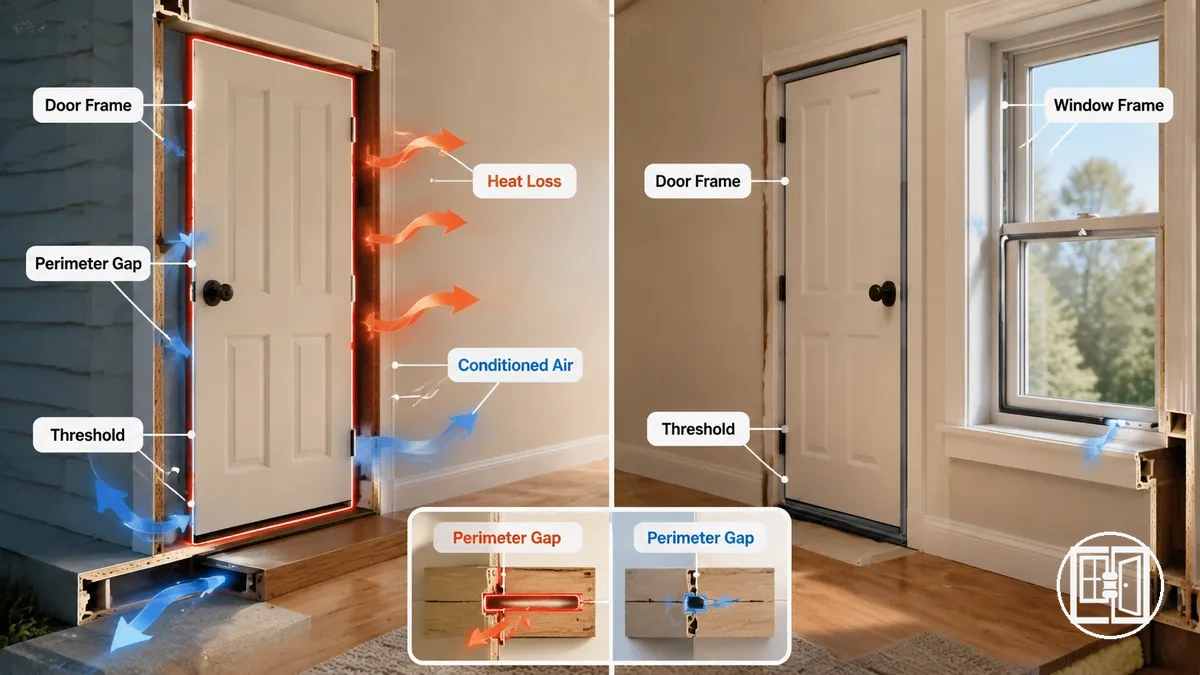
A small continuous perimeter gap can allow ongoing air exchange even when it appears minor, so its effect is not determined by visible size alone. For example, a narrow gap that extends along a door frame or window frame may contribute to more heat loss or heat gain than a slightly larger gap confined to a short section because the leakage condition exists over a longer path.
Common gap locations that can contribute to local heat loss include:
- Door frame: Perimeter gaps can create a draft path that increases air exchange.
- Threshold: Openings beneath the door can allow conditioned air to escape and outdoor air to enter.
- Window frame: Gaps around the frame can contribute to unwanted heat loss or heat gain.
- Sash edge: Incomplete contact along the sash edge may increase the leakage condition around the window.
Lower heating and cooling demand from a tighter seal
A tighter seal can help reduce heating demand and cooling demand when air leakage is present around doors and windows. The effect depends on seal continuity, compression, leakage severity, HVAC runtime, and indoor temperature stability rather than on weather stripping alone.
When weather stripping maintains continuous contact with the frame, proper compression helps reduce the escape of conditioned air and limits unwanted airflow through perimeter gaps. This tighter seal may reduce HVAC runtime because less conditioned air is lost during normal operation. The overall workload reduction varies with climate load, leakage severity, and how consistently the opening remains sealed when closed.
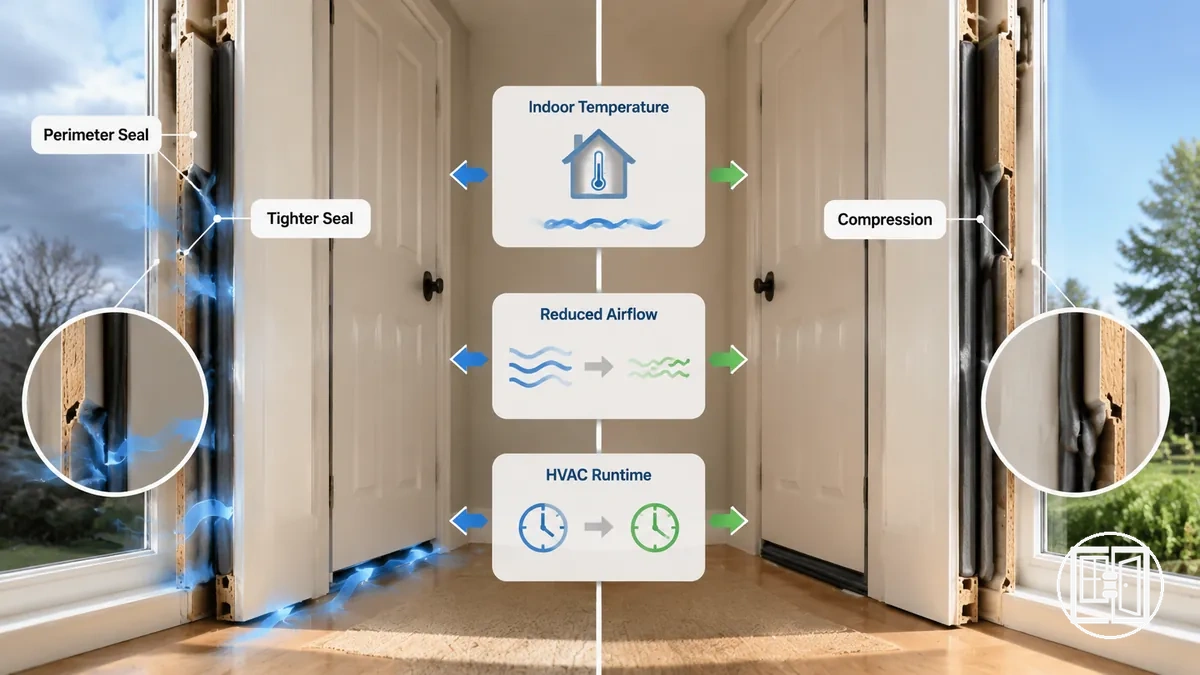
Reduced heating and cooling workload is more likely when these conditions are present:
- Obvious drafts: Noticeable airflow suggests leakage that may respond to a tighter seal.
- Continuous contact: The perimeter seal remains compressed around the entire opening.
- Gap severity: Larger or continuous gaps often provide greater opportunity for leakage reduction.
- HVAC use: Frequent heating or cooling operation can make changes in HVAC runtime more noticeable.
- Climate load: Larger indoor-to-outdoor temperature differences can increase the effect of a tighter seal.
- Stable closure: Doors and windows close consistently without leaving perimeter gaps.
Noise Reduction Benefits From Sealing Air Gaps
Weather stripping can provide noise reduction when airborne sound travels through air gaps around doors and windows. By reducing sound leakage around frames, thresholds, sash edges, and door bottoms, it can help limit gap-related noise. The amount of reduction depends on how much of the outside noise is using these air-gap sound paths.
Airborne sound can pass through small openings even when a door or window appears closed. Weather stripping improves air gap closure by creating closer contact between moving parts and surrounding frames, which can reduce sound leakage around the perimeter. This approach is most effective for gap-related noise rather than sound travelling directly through solid building elements. The overall result depends on construction details and the intensity of the outside noise.
The comparison below distinguishes gap sealing from broader sound transmission control.
| Gap sealing helps with | Gap sealing may not solve |
|---|---|
| Air gaps carrying airborne sound | Sound passing directly through glass |
| Sound leakage around door bottoms | Noise influenced by wall mass or door core construction |
| Window edge leakage around frames and sash edges | Sound transmission affected by frame construction |
| Gap-related outside noise | High external noise intensity travelling through multiple building elements |
Weather stripping can help reduce sound leakage through air gaps, but it is not a complete soundproofing or acoustic treatment solution. Glass thickness, wall mass, door core design, frame construction, and noise intensity may still have a significant influence on overall sound transmission.
Airborne sound paths around frames and thresholds
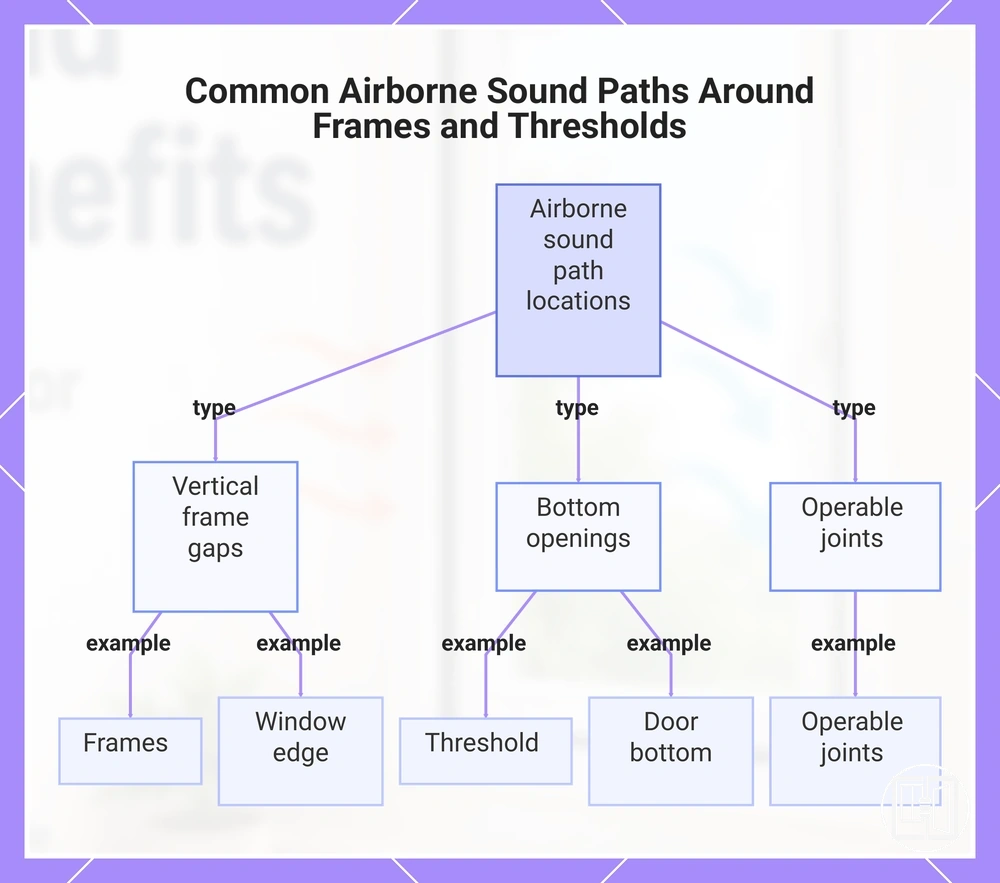
Airborne sound can pass through small openings around frames, thresholds, and operable joints when a continuous air path is present. Reducing these openings can help limit sound leakage, but the amount of reduction depends on the location and continuity of the gap.
The most common sound-path locations include:
- Frames: Small openings around the frame can create an air path for airborne sound.
- Thresholds: Gaps at the threshold may allow sound leakage beneath a closed door.
- Operable joints: Meeting points between moving parts can become sound paths if they do not seal closely.
- Door bottom: A continuous gap below the door can allow outside noise to pass indoors.
- Window edge: Gaps along the window edge may let airborne sound travel through the opening.
For example, street noise may be more noticeable through an unsealed door bottom or window edge when those small openings create a continuous air path.
This chart shows the common locations where airborne sound can pass through small openings when a continuous air path is present.
Why weather stripping reduces noise without fully soundproofing
Weather stripping can reduce noise that passes through gaps, but it usually cannot fully soundproof a room by itself. Seal compression helps reduce air leakage and sound leakage around doors and windows, while the overall result still depends on factors such as door mass, window glazing, wall construction, and external noise intensity.
Gap sealing and full soundproofing perform different roles. Weather stripping helps reduce sound transmission through small openings, but it does not stop sound that travels through glass, door panels, or wall construction. This distinction explains why sealing gaps can improve noise control without providing complete acoustic isolation.
| Weather stripping can reduce | Weather stripping usually cannot control alone |
|---|---|
| Sound leakage through gaps | Glass transmission |
| Noise entering around door bottoms | Sound affected by door mass |
| Noise entering around window edges | Sound affected by wall construction |
| Air leakage that carries outside noise | Loud external noise |
For example, weather stripping may noticeably reduce traffic noise when it enters through unsealed gaps around a door or window. If most sound is transmitted through glazing or wall construction instead of gaps, broader acoustic upgrades may provide additional noise reduction.
When Weather Stripping Delivers Noticeable Energy and Noise Benefits
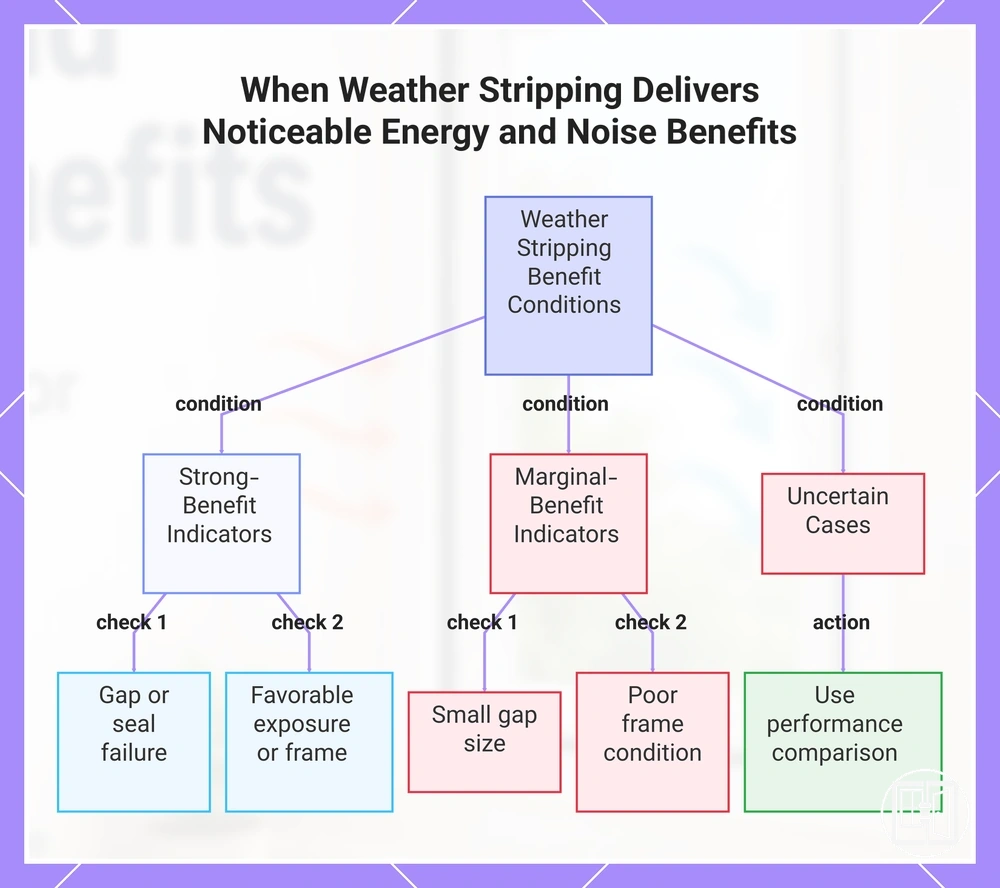
Noticeable benefits are most likely when a door or window has visible gaps, failed seals, or high-exposure openings. These conditions increase the likelihood of energy loss and sound leakage, so improving seal contact can provide stronger results for both energy efficiency and noise reduction. If gaps are already minimal and seals remain effective, the benefit may be more marginal.
Benefit strength depends on gap size, seal contact, exposure, and frame condition rather than on weather stripping alone. Larger gaps or failed seals often create greater opportunity for improvement, while high-exposure openings affected by wind or a frequent noise path may show more noticeable results. A damaged or poorly aligned frame can limit sealing performance even when new weather stripping is installed.
The checklist below helps separate strong-benefit cases from marginal-benefit cases and provides practical decision signals.
- Visible gaps: More likely to deliver noticeable benefits by reducing energy loss and sound leakage.
- Failed seals: Restoring consistent seal contact can increase benefit strength.
- High-exposure openings: Doors or windows exposed to wind or frequent outside noise often show stronger results.
- Good frame condition: A stable frame supports more consistent sealing and more reliable outcomes.
- Small gap size: When leakage is already limited, only a marginal benefit may be noticeable.
- Uncertain conditions: A performance comparison can help assess whether stronger or more limited energy and noise benefits are likely.
This chart shows the key conditions that determine whether weather stripping will provide noticeable energy and noise benefits, separating strong-benefit cases from marginal or uncertain ones.
Gap size, seal compression, and frame condition
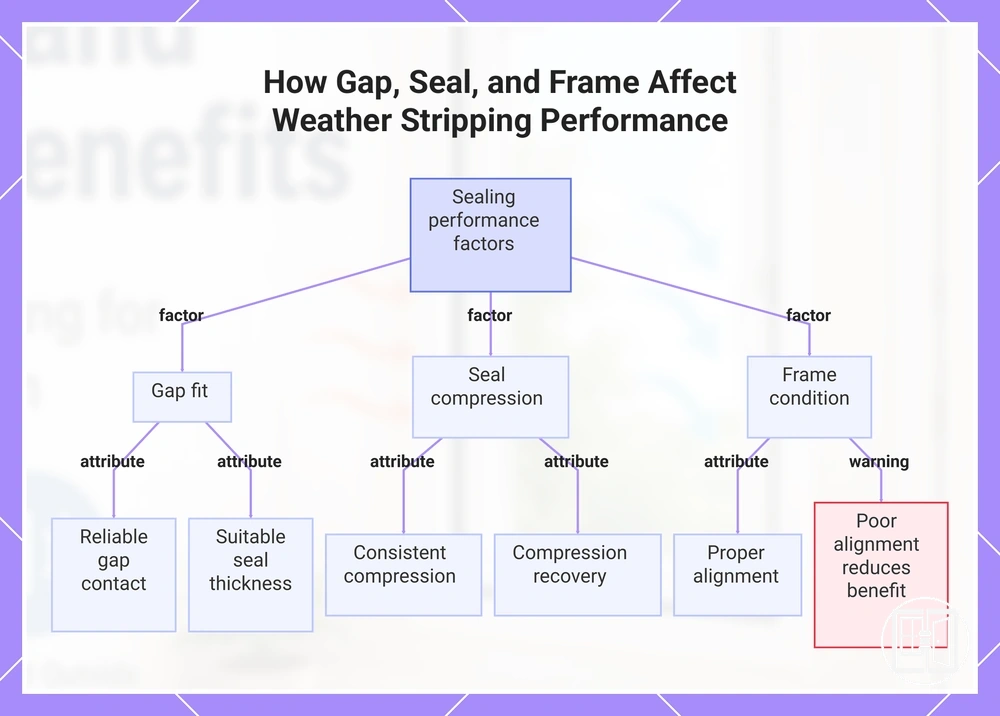
Gap size, seal compression, and frame condition determine whether weather stripping can seal effectively. A suitable seal should match the physical gap and compress enough to maintain seal contact without preventing normal door or window closure. If the fit or compression is unsuitable, sealing performance may be limited.
Gap width, seal thickness, compression recovery, and frame condition work together to influence closure and seal contact. Even when a suitable seal is used, poor frame alignment or damaged surface condition may reduce the benefit by limiting consistent contact along the opening.
- Gap width: Should allow the seal to make reliable contact without leaving open spaces.
- Seal thickness: Should suit the gap size so normal closure remains possible.
- Seal compression: Consistent compression helps maintain continuous seal contact.
- Compression recovery: Good recovery helps the seal return to its working shape after repeated closure.
- Frame alignment: Proper alignment supports even contact across the opening.
- Boundary: Poor frame alignment or damaged surface condition may reduce sealing performance even with a suitable seal.
This chart shows the main determinants of weather stripping seal performance: gap fit, seal compression, and frame condition, along with their key attributes.
Doors and windows with higher leakage exposure
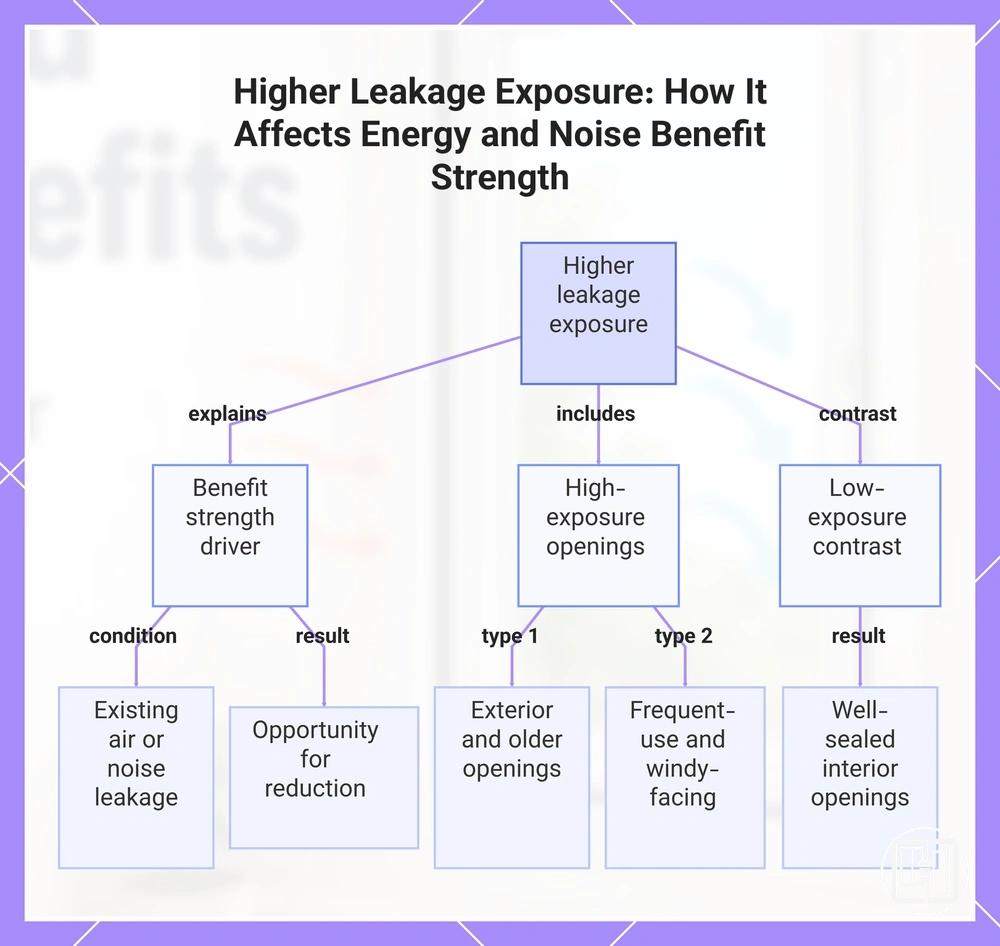
Doors and windows with higher leakage exposure are more likely to show noticeable energy and noise benefits when existing air leakage or sound leakage is present. Exterior exposure, frequent use, and older openings can increase the likelihood of a leakage path or noise path, although benefit strength still depends on the condition of the opening and its seals.
For example, a high-exposure exterior door with existing leakage may show stronger improvement than a well-sealed interior-facing opening because there is more opportunity to reduce unwanted air and sound movement. The examples below highlight situations where benefit strength may be greater.
- Exterior doors: Higher leakage exposure can create a larger leakage path, increasing potential benefit strength.
- Older windows: Frame wear or aging seals may increase air leakage and create a more noticeable noise path.
- Frequent-use entrances: Repeated opening and closing can increase leakage risk as seal contact changes over time.
- Windy-facing openings: Greater exposure may make existing air leakage and noise paths more noticeable.
- Well-sealed interior-facing openings: When leakage is already limited, any additional benefit is more likely to be marginal.
This chart illustrates how higher leakage exposure in doors and windows creates greater opportunities for energy and noise improvement, along with examples of high- and low-exposure openings.
How Much Energy Savings Depend on the Home
Energy savings from weather stripping depend on home condition, climate, HVAC use, and leakage severity. Weather stripping can help reduce unwanted air leakage, but savings uncertainty remains because overall energy use is influenced by multiple home-level variables rather than the seal alone.
Home condition influences how much difference improved sealing may make. Climate affects heating and cooling demand, HVAC use influences system runtime, and insulation condition affects how efficiently the home retains conditioned air. Existing leakage and seal quality also shape the potential benefit, so a home with obvious drafts may experience more noticeable changes than a tightly sealed home with limited air leakage.
The table below summarizes the main home variables that influence energy savings. Without measuring actual energy use before and after sealing, exact bill savings or heating and cooling cost predictions should not be assumed.
| Home factor | Why it changes savings | Safe interpretation |
|---|---|---|
| Climate | Changes heating and cooling demand throughout the year. | Energy savings may vary with climate load. |
| HVAC use | More system runtime can increase the effect of reducing air leakage. | Savings depend on how often heating or cooling is used. |
| Leakage severity | Existing leakage affects how much unwanted air movement can be reduced. | Homes with obvious drafts may have greater potential than tightly sealed homes. |
| Insulation condition | Overall thermal performance influences energy use. | Weather stripping is one factor contributing to savings uncertainty. |
| Seal quality | Consistent seal contact helps limit uncontrolled air leakage. | Benefits depend on how effectively the seal performs in the home. |
Climate, HVAC use, and existing leakage levels
Climate, HVAC use, and existing leakage levels influence the potential energy effect of weather stripping because they affect how often unwanted air leakage increases heating or cooling demand. No single variable predicts energy savings on its own, as the overall value depends on the combined effect of climate, home use, and leakage conditions.
A heavily conditioned leaky home with frequent HVAC use and noticeable outdoor temperature swings may have greater potential for benefit than a mild-climate home with limited HVAC use and minimal existing leakage. This comparison is illustrative rather than predictive because room exposure, draft severity, and other home conditions also influence the likely energy effect.
The table below summarizes the three main variables that modify the potential value of weather stripping without implying a precise savings prediction.
| Variable | Higher-impact condition | Lower-impact condition |
|---|---|---|
| Climate | Greater outdoor temperature swings and higher climate load | Milder climate with smaller temperature changes |
| HVAC use | Frequent heating or cooling patterns and higher HVAC frequency | Limited HVAC use during the year |
| Existing leakage | Higher draft severity and greater room exposure to air leakage | Lower leakage levels with limited drafts |
Why door seals alone cannot determine total bill savings
Door seals can contribute to total bill savings, but they cannot determine utility bill changes by themselves. Utility bills reflect multiple building variables and usage patterns, so the effect of weather stripping depends on how it works alongside other parts of the home rather than as a single cause.
The outcome can also be influenced by window seals, insulation, glazing, HVAC efficiency, thermostat settings, occupancy, and weather. These factors interact, so no single air-sealing improvement can reliably determine total bill savings even when weather stripping helps reduce unwanted air leakage.
- Door and window seals: Can reduce uncontrolled air leakage when gaps are present.
- Insulation and glazing: Influence how effectively the building retains conditioned air.
- HVAC efficiency and thermostat settings: Affect heating and cooling energy use.
- Occupancy and weather: Change energy demand and usage patterns over time.
Weather stripping is one controllable air-sealing input, not a whole-home energy audit or a complete explanation of total utility bill outcomes.
Limits of Weather Stripping for Insulation and Sound Control
Weather stripping mainly controls air leakage, and its limits depend on whether heat loss or noise is primarily caused by gaps or by other building components. Air sealing, insulation, glazing, ventilation, and acoustic mass each address different aspects of building performance, so weather stripping may improve comfort without controlling every source of heat flow or sound transmission.
Weather stripping reduces unwanted air leakage around movable doors and windows, while insulation upgrades primarily limit conductive heat transfer through building materials. Glazing affects heat flow through windows, ventilation manages planned air exchange, and acoustic mass helps reduce sound transmission through walls, door cores, and other solid elements. These measures perform different functions and often complement rather than replace one another.
| Weather stripping mainly changes | Other upgrades may be needed for |
|---|---|
| Air leakage control around obvious gaps | Conductive heat transfer through building materials |
| Gap sealing around doors and windows | Glazing performance |
| Reducing uncontrolled air exchange | Ventilation requirements |
| Limiting sound entering through air gaps | Sound transmission through acoustic mass |
These limits are context-dependent and should help set realistic expectations rather than discourage sealing obvious gaps. Weather stripping remains a useful air-sealing measure, while the overall outcome depends on which building elements contribute most to heat flow or sound transmission.
Air sealing versus broader insulation upgrades
Air sealing and insulation upgrades serve related but different building-performance functions. Weather stripping mainly reduces unwanted air movement through gaps, while insulation upgrades mainly reduce heat transfer through materials. Glazing and door construction can also influence comfort and energy performance depending on where heat loss or drafts originate.
The comparison below highlights how these approaches differ without suggesting that one replaces the other. Each addresses a different weakness, so the likely outcome depends on the building condition and the source of the problem.
| Air sealing with weather stripping | Broader insulation upgrades |
|---|---|
| Primary function: Helps reduce unwanted air movement through gaps. | Primary function: Helps reduce heat transfer through materials. |
| Best-fit weakness: Drafts around doors, windows, and other openings. | Best-fit weakness: Heat flow through walls, ceiling insulation, glazing, and other building materials. |
| Typical limitation: May not control heat transfer through door construction or other solid materials alone. | Typical limitation: May not address unwanted air movement when gaps remain unsealed. |
| Example outcome: A drafty door may feel more comfortable after air sealing. | Example outcome: Insulating a ceiling may help reduce conductive heat flow through that part of the building. |
For example, sealing a drafty door and insulating a ceiling can both improve comfort, but they mainly address different weaknesses within the building envelope.
Airtight sealing benefits and ventilation boundaries
Airtight sealing can improve comfort and energy efficiency by reducing unwanted gaps, but it should not replace healthy ventilation. The key safety boundary is that air sealing targets uncontrolled air leakage, while designed ventilation paths support intentional indoor air exchange.
Ventilation boundaries depend on how a building manages indoor air exchange, moisture control, and any combustion-appliance context. Airtight sealing can help reduce drafts without blocking intentional ventilation, and condensation risk may still depend on building conditions rather than air sealing alone. Where unusual moisture, persistent condensation, or combustion safety concerns are present, professional evaluation may be appropriate instead of assuming weather stripping is the only factor.
- Caution: Avoid blocking designed ventilation paths that provide intentional ventilation.
- Monitor: Unusual moisture or persistent condensation after air-sealing changes.
- Consider: Combustion-appliance context when evaluating ventilation boundaries.
- Boundary: Unusual moisture, condensation, or combustion safety concerns may warrant professional evaluation.
Benefit Signals to Check After Weather Stripping
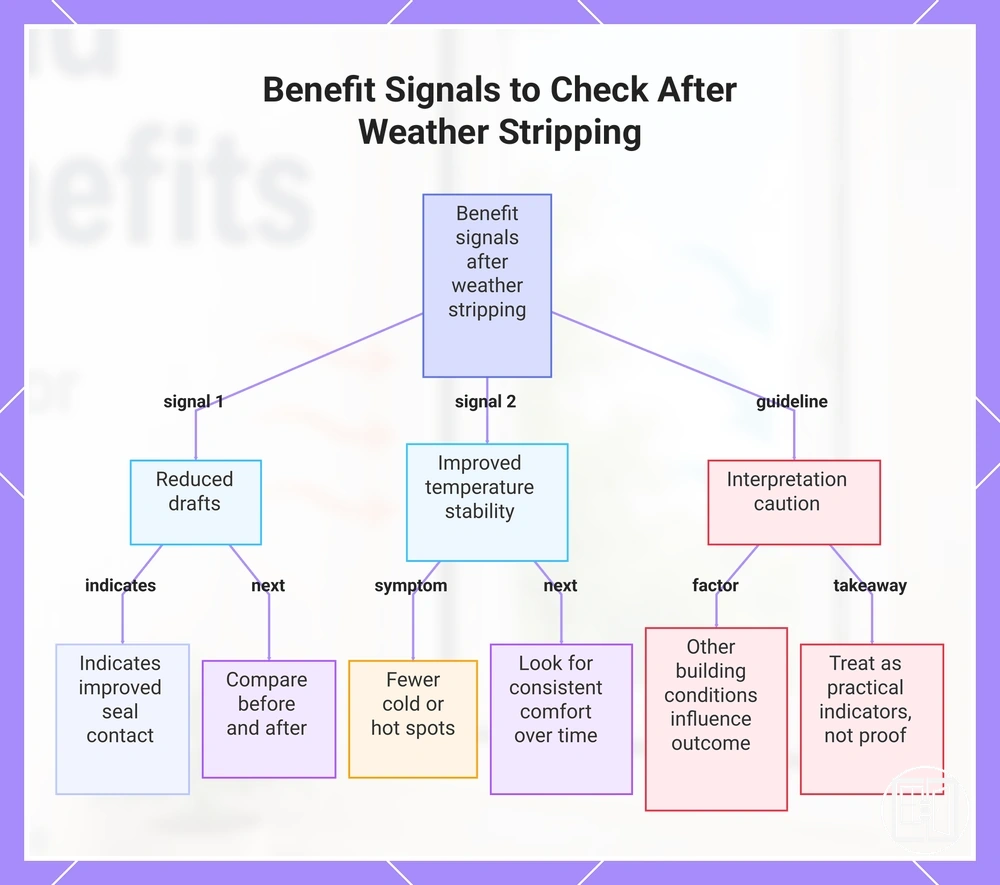
Benefit signals should be evaluated through observable changes rather than assumed automatically. Reduced drafts, improved temperature stability, quieter noise entry, and consistent seal contact can indicate practical improvement after weather stripping, while exact energy savings require measured data.
Before-and-after observations provide qualitative cues that sealing may be performing as intended. Rooms that previously had noticeable cold spots or hot spots may feel more stable, gap-related noise may become less noticeable, and HVAC cycling may appear smoother in some homes. These observations are useful evidence cues, but they should be interpreted cautiously because other building conditions can also influence the outcome.
The checklist below focuses on observable signs rather than guaranteed results. Each signal should be viewed as a practical indicator instead of proof of a specific level of energy or noise improvement.
- Reduced drafts: May indicate improved seal contact around unwanted gaps. Next interpretation: Compare conditions before and after sealing instead of relying on a single observation.
- Improved temperature stability: Fewer cold spots or hot spots may suggest reduced unwanted air movement. Next interpretation: Look for consistent comfort over time rather than a one-time change.
- Quieter noise entry: Less gap-related noise may indicate better sealing around doors or windows. Next interpretation: External noise levels and building construction can also affect what is heard.
- Smoother HVAC cycling: Heating or cooling may appear to operate more consistently in some situations. Next interpretation: Treat this as a qualitative cue unless measured system data is available.
- Consistent seal contact: Even contact around the opening may indicate effective air sealing. Next interpretation: Confirm that the seal continues to make consistent contact during normal operation.
This chart shows the key observable signals that indicate effective weather stripping and the cautious interpretation approach required.